

The top news stories from Australia
Provided by AGP
Australia Self Storage Market 2026 | Size, Outlook, Share
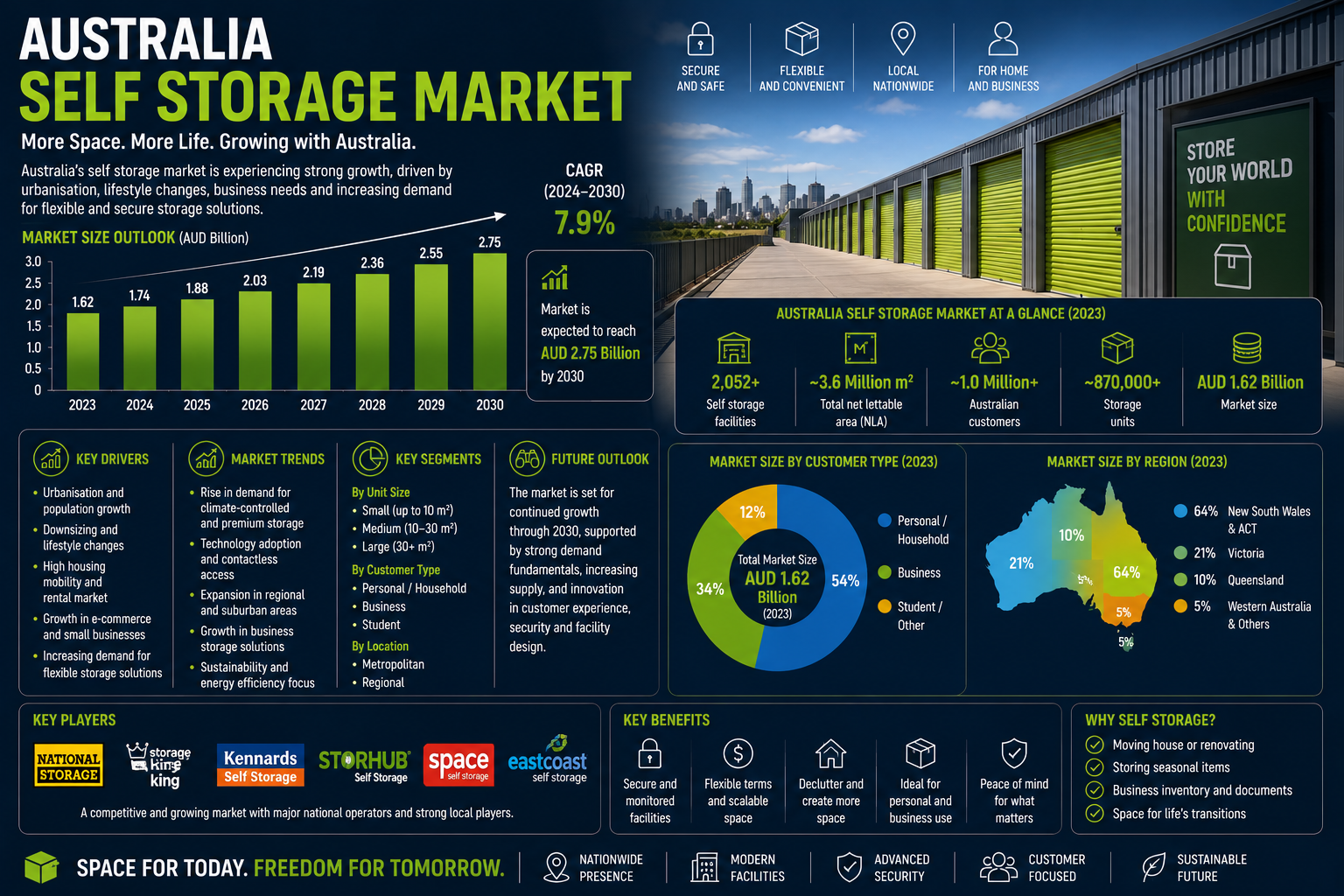
Australia self storage market size reached USD 1,260.9 Million in 2025., is expected to reach USD 1,899.0 Million by 2034, CAGR of 4.66% during 2026-2034.
AUSTRALIA, May 14, 2026 /EINPresswire.com/ --Market Overview:
The Australia self storage market reached USD 1,260.9 Million in 2025 and is expected to reach USD 1,899.0 Million by 2034, exhibiting a growth rate (CAGR) of 4.66% during 2026–2034. The market is experiencing robust expansion driven by rising urban density and shrinking dwelling sizes across Sydney, Melbourne, and Brisbane, where approximately 86.6% of Australia’s population resides in urban areas. Frequent housing transitions, e-commerce growth, and the increasing shift toward apartment living are generating sustained demand for flexible off-site storage solutions. With record transaction activity exceeding $5.5 billion AUD in 2025, institutional investors are accelerating consolidation, while smart technology adoption and regional facility expansion are reshaping the competitive landscape across metropolitan and emerging growth corridors.
Why is the Hot Today Australia Self Storage Market?
Major deals negotiated throughout 2025 exceeded $5.5 billion AUD, including a $4 billion takeover of National Storage by a Brookfield-GIC consortium, Kennards Self Storage’s acquisition of National Mini Storage for approximately $500 million NZD, BlackRock’s majority stake in StoreLocal, and Barings’ majority stake in Swift Storage; the Self Storage Association of Australasia’s 2025 Industry Snapshot revealed that 73% of operators expect improved conditions over the next 12 months; around half of operators are now using or trialing AI with measurable gains in marketing and pricing optimization; and 87% of all self-storage deals were acquired by private-equity groups, fundamentally shifting ownership away from the historically dominant REITs.
Australia Self Storage Market Summary:
• Residential customers account for approximately 80% of self-storage rentals across Australia, with demand primarily driven by urban downsizing, housing market volatility, and frequent relocations — as rising property prices, changing interest rates, and shifting employment patterns compel individuals and families to seek secure, flexible storage solutions during transitional living periods and settlement delays.
• The competitive landscape is dominated by three major operators — Kennards Self Storage with 126 operating centres and over 910,000 square metres of rentable space, Abacus Storage King with a $3.4 billion portfolio comprising 128 facilities across Australia and New Zealand, and National Storage REIT — collectively controlling approximately 59% of the organized market by net storage area.
• The e-commerce boom is generating consistent commercial demand for self-storage, with Australia’s e-commerce market valued at approximately USD 536 billion in 2024 and projected to grow at 12.7% CAGR through 2033 — driving online retailers, freelancers, and tradespeople to utilize storage units as affordable alternatives to commercial warehouse leasing for inventory management and equipment storage.
• Around 55% of the pending new supply pipeline is concentrated within Brisbane, Melbourne, and Sydney — the three East Coast cities forming the core of Australia’s self-storage demand — with another 10% within Adelaide, Auckland, and Perth, and the remaining 35% targeting secondary markets where population migration and lifestyle relocation are driving localized demand spikes.
• Private-equity dominance in self-storage acquisitions represents a fundamental transformation in ownership structure, with 87% of deals in 2025 acquired by institutional groups including BlackRock, Barings, Brookfield, and Warburg Pincus-backed StorHub — displacing the historical pattern where REITs captured 50% to 80% of transactions and injecting global operational sophistication into the sector.
• Smart technology and automation adoption is accelerating, with one in three facilities now operating a partially remote model, operators deploying digital access systems, smart locks, automated kiosks, and AI-powered pricing optimization — while mobile apps for remote access, real-time alerts, and automated billing are becoming standard expectations among digital-native consumers.
• Sustainability is emerging as a strategic priority, with operators investing in solar panels, recycled construction materials, energy-efficient lighting, and climate control systems — achieving sustainability certifications that serve as strong differentiators in a competitive market where environmentally conscious consumers increasingly prioritize green choices across all service categories.
How AI is Reshaping the Australian Self Storage Market:
Artificial intelligence is rapidly emerging as a transformative force across the Australia self storage market, fundamentally reshaping how facilities are operated, marketed, priced, and managed — delivering a new generation of operational efficiency, customer engagement, and revenue optimization that is critical to sustaining competitive advantage as the industry undergoes accelerated consolidation and professionalization throughout the forecast period.
• AI-Powered Dynamic Pricing and Revenue Management: Machine learning algorithms are enabling Australian self-storage operators to implement real-time dynamic pricing models that analyze occupancy rates, seasonal demand patterns, competitor pricing, and customer behavior data to automatically adjust unit rates — maximizing revenue per available square metre while maintaining competitive positioning across metropolitan and regional markets.
• Automated Customer Engagement and Leasing Workflows: AI-enabled voice agents, chatbots, and automated leasing platforms are making it possible for self-storage operators to engage, qualify, and convert prospects around the clock without adding headcount — with the SSAA’s 2025 Industry Snapshot confirming that around half of operators are now using or trialing AI with measurable gains in enquiry handling and customer conversion rates.
• Predictive Analytics for Demand Forecasting and Capacity Planning: AI-driven predictive modeling platforms are enabling facility operators and investors to forecast occupancy trends, identify emerging demand corridors, and optimize new facility development decisions based on population growth data, housing market dynamics, e-commerce activity, and migration patterns across Australia’s metropolitan and regional markets.
• Smart Facility Operations and Remote Management: AI-powered smart building systems integrating IoT sensors, automated climate control, digital access management, and real-time security monitoring are enabling operators to manage facilities remotely — with one in three Australian self-storage facilities now operating a partially remote model that reduces staffing costs while improving operational consistency and customer experience.
• AI-Assisted Marketing Automation and Customer Analytics: Natural language processing and machine learning tools are enabling operators to optimize digital marketing campaigns, automate SEO and paid advertising strategies, and analyze customer behavior patterns — delivering targeted acquisition and retention programs that reduce customer acquisition costs while improving lifetime value across increasingly competitive metropolitan and regional markets.
Request a Business Sample Report for Procurement & Investment Evaluation: https://www.imarcgroup.com/australia-self-storage-market/requestsample
Market Trends and Insights:
• The growing urban population in major cities is driving a structural reduction in average dwelling sizes — with new residential developments focused on high-rise apartments and compact homes offering diminished in-unit storage — compelling residents to seek external solutions for seasonal items, recreational equipment, archived documents, and infrequently used possessions, while developers market smaller apartments assuming external storage supplementation.
• The rapid expansion of e-commerce and home-based businesses is creating a structurally growing category of commercial self-storage demand — with online retailers, sole proprietors, freelancers, artists, and tradespeople utilizing storage units as affordable and scalable alternatives to commercial warehouse leasing, while providers offer value-added services including parcel acceptance, delivery coordination, and shelving installations.
• Private-equity capital is reshaping Australia’s self-storage ownership landscape at unprecedented scale, with the $4 billion Brookfield-GIC takeover of National Storage representing the sector’s largest-ever transaction — while institutional investors captured 87% of industry transactions in 2025, bringing global operational sophistication and consolidation momentum that is professionalizing the industry.
• Regional expansion beyond the three East Coast metro centres is opening significant new growth corridors, with operators developing facilities near highways, industrial zones, and regional commercial centres in secondary markets benefiting from population migration, lifestyle-driven relocation, improved transport infrastructure, and lower land costs — with approximately 35% of pending new supply targeting these emerging areas.
• Housing market volatility — driven by rising property prices, changing interest rates, and shifting employment patterns — is creating a sustained cycle of transitional living that structurally benefits self-storage demand, with individuals and families frequently relocating, downsizing, or renting for interim periods and requiring secure, flexible storage during settlement delays and renovation schedules.
• Australia’s ageing population is increasingly shifting toward smaller residences such as retirement villages and low-maintenance housing — creating consistent demand from older adults seeking secure, accessible off-site solutions for storing furniture, keepsakes, family heirlooms, and seasonal items, with providers offering user-friendly access, safety features, and flexible terms tailored to this growing demographic segment.
Market Growth Drivers:
Urban Densification, Housing Volatility, and Demographic Shifts
Australia’s self-storage market is primarily driven by the structural reduction of dwelling sizes across major urban centres, where approximately 86.6% of the population resides. Rising property prices and housing market volatility are compelling frequent relocations, downsizing, and transitional living arrangements that generate sustained demand for flexible, secure off-site storage. The ageing population is simultaneously shifting toward smaller residences, prompting older adults to seek external storage. Interstate migration and regional relocation remain strong, driving localized demand spikes in growth corridors. Together, urban densification, housing instability, demographic ageing, and population mobility are creating a powerful structural foundation for sustained self-storage market expansion across metropolitan and regional Australia.
E-Commerce Expansion, Small Business Demand, and Commercial Storage Growth
The explosive growth of Australia’s e-commerce sector — valued at approximately USD 536 billion in 2024 with a projected 12.7% CAGR through 2033 — is generating consistent and expanding commercial demand from online retailers, sole proprietors, and home-based businesses requiring affordable alternatives to commercial warehouse leasing. Self-storage units serve as scalable solutions for inventory management, packaging supplies, and equipment storage, with operators offering value-added services including parcel acceptance and delivery coordination. The diversification of user segments to include freelancers, artists, and tradespeople is broadening the commercial customer base. These commercial demand dynamics complement residential demand, creating a balanced and resilient revenue structure.
Institutional Investment, Technology Adoption, and Industry Professionalization
The unprecedented inflow of institutional capital — with private-equity groups capturing 87% of industry transactions in 2025, including the landmark $4 billion Brookfield-GIC takeover of National Storage — is transforming Australia’s self-storage sector into an institutionally sophisticated industry. Major operators like Kennards (126 centres, $4 billion+ value) and Abacus Storage King ($3.4 billion portfolio, 128 facilities) are driving consolidation. Simultaneously, technology adoption is accelerating with half of operators using or trialing AI, one in three facilities operating partially remote models, and vendors introducing AI-enabled voice agents and dynamic pricing tools. This convergence of capital, consolidation, and automation is creating a higher-barrier, higher-value competitive landscape.
Market Segmentation:
IMARC Group’s research categorizes the Australia self storage market as follows:
By Storage Unit Size:
• Small Storage Unit
• Medium Storage Unit
• Large Storage Unit
By End Use:
• Personal
• Business
By Region:
• Australia Capital Territory & New South Wales
• Victoria & Tasmania
• Queensland
• Northern Territory & Southern Australia
• Western Australia
Speak to an Analyst: https://www.imarcgroup.com/request?type=report&id=33038&flag=E
Key Players:
The competitive landscape of the Australia self storage market includes a comprehensive analysis of key player positioning, market structure, top winning strategies, competitive dashboards, and company evaluation quadrants. Some of the key players operating in the market include Kennards Self Storage, Abacus Storage King, National Storage REIT, StorHub (Warburg Pincus), StoreLocal (BlackRock), and Storage King. Detailed profiles of all major companies are provided within the full IMARC Group research report.
Recent News and Developments:
2025: A consortium backed by Brookfield Asset Management and GIC completed the approximately $4 billion takeover of National Storage REIT — the largest self-storage transaction in Australian history — delisting the entity and signaling the accelerating institutionalization of the sector as global infrastructure and sovereign wealth capital displaces traditional REIT ownership structures.
2025: Kennards Self Storage acquired National Mini Storage in New Zealand for approximately $500 million NZD, adding 13 Grade A operating locations with 11,272 storage spaces and 99,247 square metres, bringing the company’s total portfolio to 126 locations across Australia and New Zealand with over 910,000 square metres of rentable space.
2025: BlackRock secured a majority stake in StoreLocal for approximately $400 million AUD and separately acquired Blackstone’s KeepSafe Storage portfolio for $165 million AUD — establishing one of the largest private-equity self-storage platforms in Australia and reinforcing institutional investor confidence in the sector’s long-term growth fundamentals.
2025: Barings acquired a majority stake in Swift Storage for approximately $200 million AUD, further intensifying the wave of institutional capital flowing into Australia’s self-storage market and contributing to the record $5.5 billion AUD in total deals negotiated throughout the year.
2025: The Self Storage Association of Australasia released its Industry Snapshot 2025, revealing that 73% of respondents expect improved conditions, 59% report business ahead of the prior year, and around half of operators are now using or trialing AI — confirming the sector’s strong operational momentum and technology adoption trajectory.
2024: StorHub, backed by Warburg Pincus, acquired three self-storage facilities in Sydney for over USD 70 million from Trumen and Norman Property Partners. National Storage REIT also announced the acquisition of a self-storage portfolio from MAAS Group Holdings Limited for USD 32 million, strengthening its national market presence.
Browse Full Report with TOC & List of Figures: https://www.imarcgroup.com/australia-self-storage-market
Other Trending Reports by IMARC Group:
Australia Mortgage Lending Market 2026: https://www.imarcgroup.com/australia-mortgage-lending-market
Australia Personal Computers Market 2026: https://www.imarcgroup.com/australia-personal-computers-market
Australia Anti-Money Laundering Market 2026: https://www.imarcgroup.com/australia-anti-money-laundering-market
Australia Modular Kitchens Market 2026: https://www.imarcgroup.com/australia-modular-kitchens-market
Australia Intellectual Property Management Market 2026: https://www.imarcgroup.com/australia-intellectual-property-management-market
Australia Publishing Market 2026: https://www.imarcgroup.com/australia-publishing-market
About Us
IMARC Group is a global management consulting firm that helps the world’s most ambitious changemakers to create a lasting impact. The company provides a comprehensive suite of market entry and expansion services. IMARC offerings include thorough market assessment, feasibility studies, company incorporation assistance, factory setup support, regulatory approvals and licensing navigation, branding, marketing and sales strategies, competitive landscape and benchmarking analyses, pricing and cost research, and procurement research.
Contact Us
IMARC Group 134 N 4th St., Brooklyn, NY 11249, USA
Email: sales@imarcgroup.com
Tel. No.: (D) +91 120 433 0800
United States: +1-201-971-6302
Elena Anderson
IMARC Services Private Limited
+ +1 201-971-6302
email us here
Legal Disclaimer:
EIN Presswire provides this news content "as is" without warranty of any kind. We do not accept any responsibility or liability for the accuracy, content, images, videos, licenses, completeness, legality, or reliability of the information contained in this article. If you have any complaints or copyright issues related to this article, kindly contact the author above.
